

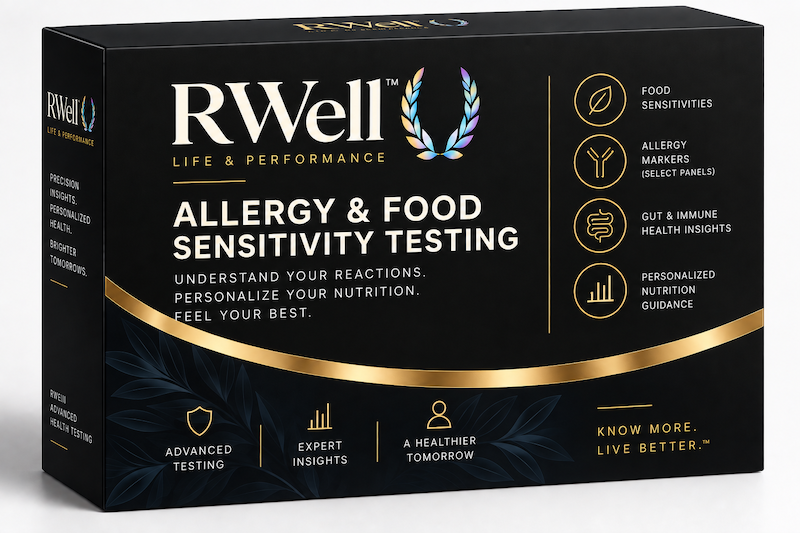
 Advanced Food Reactivity Testing, Interpretation & Personalized Guidance
Understanding Your Relationship With Food
Food-related symptoms can be difficult to understand. A food that is well tolerated by one person may be associated with symptoms in another, and identifying meaningful patterns can become challenging when many foods are part of the diet.
At RWell Center, our role is to help patients investigate possible food-related concerns through advanced testing, and help interpret the findings alongside their symptoms.
Our Role in Food Allergy & Sensitivity Testing
RWell Center is not an allergy center, and our testing does not replace evaluation by an allergist when one is medically indicated.
This distinction is particularly important because food sensitivity is not the same as food allergy.
Conventional food allergy typically involves IgE-mediated immune reactions, which can sometimes cause serious or potentially life-threatening reactions such as anaphylaxis. RWell™ Food Sensitivity Testing is not intended to diagnose IgE-mediated food allergy or predict the risk of anaphylaxis.
Patients with suspected food allergy, significant allergic reactions, hives, swelling, breathing difficulty or a history of anaphylaxis should undergo appropriate evaluation by an allergist or other qualified medical professional.
Our role is complementary:
Test → Interpret → Understand → Guide Appropriate Next Steps
What Does RWell™ Food Sensitivity Testing Evaluate?
Testing evaluates immune reactivity to a broad range of foods, food proteins, peptides and whole-food extracts.
- Dairy & Proteins — Milk, whey, beta-casein, eggs, meats and related proteins.
- Grains & Gluten-Containing Foods — Wheat, barley, rye, oats, spelt and other grains.
- Fruits & Vegetables — A broad range of commonly consumed fruits and vegetables.
- Fish & Shellfish — Fish, shellfish and other seafood.
- Nuts, Seeds & Legumes — Peanuts, tree nuts, seeds, soy, beans and legumes.
- Spices & Other Foods — Spices, coffee, tea, cocoa, yeast and other commonly consumed foods.
A Positive Result Does Not Always Mean “Stop Eating That Food”
This is an important part of interpretation.
A positive laboratory finding does not necessarily mean a food must be permanently eliminated. Automatically removing every food identified on a laboratory report can result in an unnecessarily restrictive diet.
At RWell Center, results are considered alongside the patient’s:
Symptoms • Diet • Medical History • Gut Health • Medications • Supplements • Nutritional Needs • Other Testing
Depending on the findings, the next step may include targeted dietary changes, nutritional guidance, additional testing, monitoring, or referral to an appropriate specialist.
The goal is not to treat a laboratory report. It is to understand what the findings may mean for the individual.
Test. Understand. Personalize. Monitor.
Food Sensitivity & Gut Health
Food-related concerns and gastrointestinal health can overlap.
When appropriate, food sensitivity findings may be considered alongside gut microbiome testing, digestive health and nutritional assessment to provide a broader picture.
Explore RWell™ Gut & Microbiome Testing
Explore RWell™ Nutrition & Nutrient Testing
Food Sensitivity Testing in Philadelphia, Manhattan & the Lehigh Valley
RWell Center provides guided food sensitivity and food reactivity testing for adults in Philadelphia and the Main Line, Manhattan and New York City, and the Lehigh Valley, including Allentown, Bethlehem and Easton.
Our role is to help patients move from testing to understanding—and from understanding to the appropriate next step, including allergy or other specialty evaluation when indicated.
Understand Your Food. Personalize Your Nutrition.


