
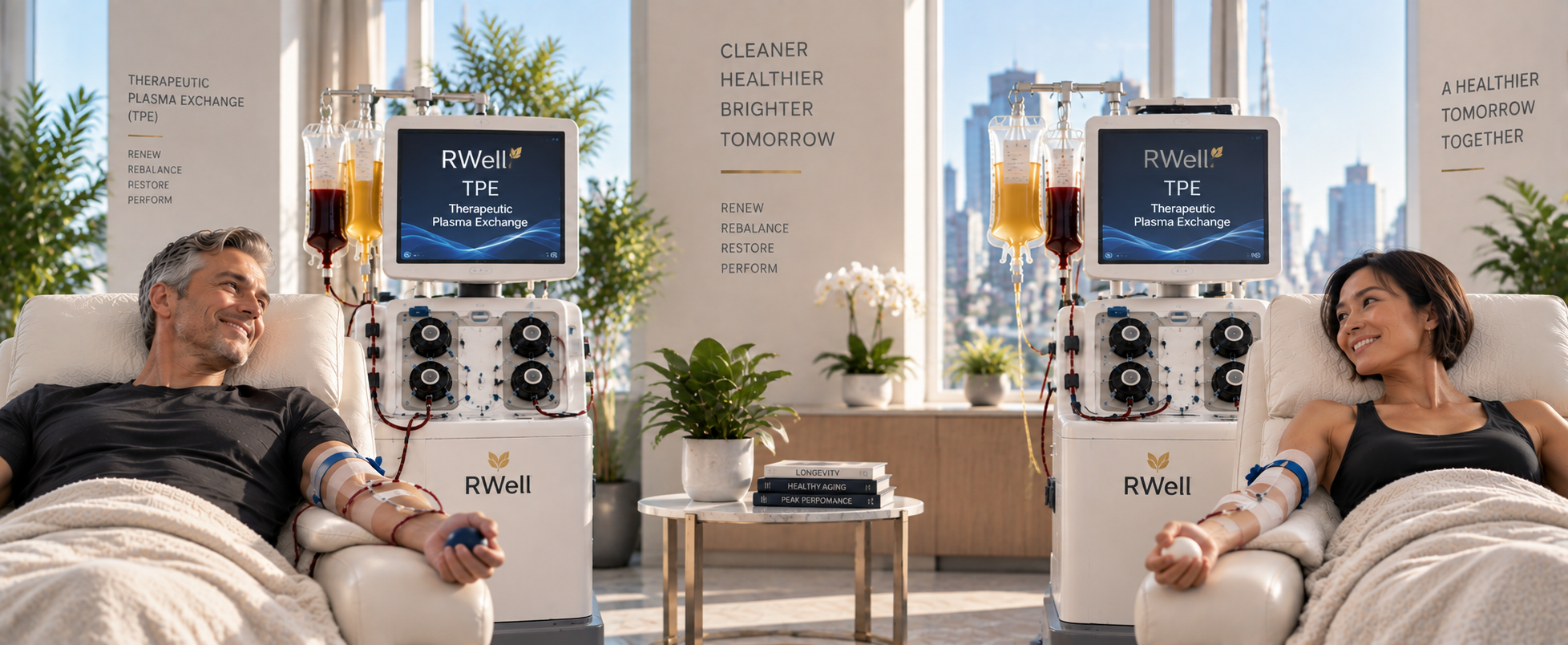
Advanced Plasma Exchange, Longevity Science & Circulating-Factor Modification
Understanding Therapeutic Plasma Exchange
Blood contains cells suspended in plasma, which carries thousands of substances throughout the body—including antibodies, inflammatory mediators, proteins, lipids, hormones, metabolic products and environmental compounds.
Therapeutic plasma exchange (TPE), sometimes referred to as plasmapheresis, is a medical procedure that separates and removes plasma while returning the patient’s blood cells to circulation. The removed plasma is replaced with an appropriate replacement fluid, commonly albumin.
TPE has been used for decades to treat selected autoimmune, neurologic, hematologic and other serious medical conditions. Today, researchers are also exploring an exciting question:
Could modifying the circulating plasma environment influence biological aging, inflammation, environmental exposures and other processes important to long-term health?
This emerging area of research is creating growing interest in TPE within longevity and preventive medicine.
How TPE Works
During TPE, blood passes through an apheresis system that separates plasma from red blood cells, white blood cells and platelets. The blood cells are returned while the removed plasma is replaced.
TPE can reduce a variety of circulating substances, including:
Autoantibodies • Immune Complexes • Abnormal Immunoglobulins • Inflammatory Mediators • Selected Lipoproteins • Protein-Bound Compounds
Unlike dialysis, which primarily removes smaller molecules and metabolic waste products, TPE removes the plasma itself and many of the proteins and protein-bound substances it contains.
Established Medical Uses
Therapeutic plasma exchange is already an established medical therapy for selected conditions, including:
Thrombotic Thrombocytopenic Purpura (TTP) • Guillain-Barré Syndrome • Myasthenia Gravis • CIDP • Anti-GBM/Goodpasture Disease • Hyperviscosity Syndromes • Selected Transplant and Antibody-Mediated Disorders
These established indications should be distinguished from newer longevity and preventive applications that remain under investigation.
TPE, Longevity & the Biology of Aging
One of the most exciting areas of plasma-exchange research is its potential relationship to biological aging and the circulating environment.
Aging does not occur only within our cells and organs. The composition of our blood changes as well. With age, changes occur in inflammatory proteins, immune signaling, metabolic factors and other circulating molecules. Chronic age-associated inflammation—sometimes called “inflammaging”—has become an important focus of longevity research.
This has led researchers to ask an intriguing question:
Can changing the circulating plasma environment influence some of the biological processes associated with aging?
TPE provides a unique way to investigate this question because it can remove and replace a substantial portion of circulating plasma—and with it, many of the proteins, inflammatory mediators and signaling molecules that change with age.
Researchers are examining potential effects on:
Epigenetic Aging • Chronic Inflammation • Immune Aging • Cellular Signaling • Senescence-Associated Factors • Metabolic Health • Tissue Repair & Regeneration
Human research is beginning to explore these possibilities. Studies have demonstrated changes in biological-aging and metabolic biomarkers following plasma removal, although results across different aging measures have not been consistent.
Why This Research Is So Interesting
Traditional longevity medicine often focuses on modifying individual factors such as cholesterol, glucose, hormones, body composition, nutrition, sleep and exercise.
Plasma-exchange research asks a different and potentially important question:
What if the circulating environment itself is another modifiable component of aging?
This does not mean TPE has been proven to slow aging or extend life. Those questions remain unanswered. But the possibility that the circulating environment may represent a modifiable component of biological aging makes plasma exchange a compelling and rapidly evolving area of longevity research.
Environmental Exposures & the Circulating Environment
Plasma carries not only substances produced within our bodies but also certain compounds associated with environmental exposure. This has created growing interest in whether plasma removal could reduce selected persistent substances circulating in the bloodstream.
PFAS — “Forever Chemicals”
PFAS are persistent environmental chemicals that can remain in the body for years and circulate bound to plasma proteins.
A 2022 randomized study of 285 Australian firefighters found that plasma donation every six weeks for one year reduced PFAS levels more than whole-blood donation or observation. PFOS decreased by 2.9 ng/mL with plasma donation versus 1.1 ng/mL with blood donation and essentially no change with observation.
The study provides important human evidence that plasma removal can meaningfully reduce certain circulating PFAS chemicals.
Whether these reductions improve long-term health remains unknown, but the findings support continued research into plasma removal, environmental exposures and longevity medicine.
Microplastics
Microplastics represent another particularly interesting and rapidly developing area of research.
A 2026 human study involving 114 patients and 174 TPE procedures demonstrated that plasma exchange reduced circulating microplastics. The investigators described this as the first demonstration that circulating microplastic levels could be reduced in human patients.
Interestingly, most of the procedures in the study were performed in patients receiving TPE for longevity support, although the study was not designed to demonstrate a longevity benefit.
Reducing microplastics in circulating blood does not yet establish that total-body microplastic burden is reduced or that doing so improves health. Nevertheless, these findings open an intriguing new area of research into the relationship between environmental exposure, the circulating environment and long-term health.
Other Environmental Compounds
The ability of TPE to remove a substance depends on factors such as protein binding, molecular size, distribution between blood and tissues, rate of redistribution and ongoing environmental exposure.
Evidence involving mycotoxins, pesticides, heavy metals and other environmental compounds varies substantially, and many of these applications remain theoretical or investigational.
For this reason, TPE should not be viewed as a universal “detoxification” procedure. A more scientifically appropriate concept is circulating-factor modification.
A New Frontier in Plasma-Based Longevity Research
Taken together, research involving biological aging, inflammaging, PFAS, microplastics, immune signaling and other circulating factors is expanding the scientific conversation around plasma exchange.
Historically, TPE has primarily been used to remove disease-causing substances such as abnormal antibodies and proteins.
Longevity research raises a broader possibility:
What happens to human biology when we intentionally change the circulating environment?
That question represents one of the more intriguing frontiers in plasma-based longevity research.
Future studies will help determine whether changes observed in the bloodstream translate into meaningful improvements in healthspan, physical function, age-related disease risk or longevity.
Other Emerging Areas of Research
Alzheimer’s Disease & Neurodegeneration
Plasma exchange has been studied in Alzheimer’s disease and other neurologic conditions, including research examining whether modifying circulating proteins and other plasma components could influence neurological function.
Long COVID & Post-Infectious Syndromes
TPE has been investigated for long COVID because of proposed mechanisms involving inflammation, immune dysregulation and circulating autoantibodies. However, randomized clinical research has not established a significant clinical benefit over sham treatment. TPE therefore remains unproven for long COVID.
Cancer & Immune Modulation
Researchers are investigating whether removing circulating cytokines, extracellular vesicles, soluble immune-checkpoint proteins and other factors could potentially influence immune responses to cancer.
TPE already has established uses for certain cancer-associated complications, such as symptomatic hyperviscosity, but using plasma exchange to influence cancer itself remains experimental.
TPE is not an established treatment for cancer and should not replace oncology-directed therapy.
What TPE Removes
An important limitation of plasma exchange is that it is not completely selective.
Along with potentially undesirable circulating substances, TPE can also remove beneficial components including:
Immunoglobulins • Fibrinogen • Coagulation Factors • Complement Proteins • Transport Proteins • Selected Protein-Bound Molecules • Certain Medications
Appropriate patient selection and medical monitoring are therefore important.
Potential Risks of TPE
Therapeutic plasma exchange is generally well tolerated when performed by an experienced medical team, but it is not risk-free.
Potential complications include:
Low Blood Pressure • Low Calcium or Magnesium • Citrate Reactions • Bleeding or Coagulation-Factor Depletion • Immunoglobulin Depletion • Allergic Reactions • Infection • Thrombosis • Vascular-Access Complications • Removal of Certain Medications
Rare serious complications can include severe allergic reactions, significant bleeding, serious infection, cardiac arrhythmias and cardiovascular or respiratory events.
The risk-benefit calculation becomes especially important when TPE is considered for an emerging or investigational application rather than an established medical indication.
Established Medicine & Emerging Longevity Science
Category: Exampes
- Established Medical Uses: TTP, Guillain-Barré, myasthenia gravis, CIDP, hyperviscosity and selected antibody-mediated disorders
- Selected Medical Uses: Certain neurologic, autoimmune, inflammatory and transplant conditions
- Emerging Research: Alzheimer’s disease, cancer immune modulation and selected immune-mediated conditions
- Longevity & Environmental Research: Biological aging, inflammaging, PFAS, microplastics and environmental exposures
The scientific evidence supporting these applications is not equivalent. A change in a laboratory value, contaminant concentration or biological-aging biomarker should not be interpreted as proof of improved health, disease prevention or increased longevity.
The RWell Approach
At RWell Center, our interest in therapeutic plasma exchange goes beyond the procedure itself.
The goal is to understand the science behind the circulating environment and how emerging research may eventually influence the way we think about longevity, inflammation, environmental exposures and healthy aging.
For each patient, important questions include:
Why is TPE being considered? • What does the scientific evidence support? • What can be measured? • What are the potential benefits? • What remains uncertain? • What are the medical risks?
The goal is not simply to remove plasma. It is to understand what we are trying to change, why it may matter and whether the available evidence justifies intervention.
Important TPE Disclaimer
Therapeutic plasma exchange is an established treatment for certain specific diseases and clinical circumstances. Proposed applications involving longevity, biological aging, PFAS, microplastics, environmental exposures and cancer-related immune modulation remain investigational or have varying levels of supporting evidence.
TPE cannot be guaranteed to prevent disease, slow aging, increase longevity or remove total-body environmental contaminants. Changes in laboratory measurements, circulating contaminants or biological-aging biomarkers do not necessarily translate into improved clinical outcomes.
TPE also carries medical risks. Patients considering treatment should undergo appropriate medical evaluation and understand the potential benefits, limitations, alternatives, uncertainties and risks.
The Future of Plasma Exchange
Therapeutic plasma exchange sits at an intriguing intersection between established medicine and emerging longevity science.
Its ability to modify the circulating plasma environment has made it an important treatment for selected diseases. New research involving biological aging, inflammaging, PFAS, microplastics and immune signaling is now raising entirely new questions about what plasma exchange may allow us to understand—and potentially influence—in the future.
Understand the Science. Measure What Matters. Personalize the Approach.
Selected References
- Padmanabhan A, et al. Guidelines on the Use of Therapeutic Apheresis in Clinical Practice – Evidence-Based Approach from the Writing Committee of the American Society for Apheresis: The Ninth Special Issue. J Clin Apher. 2023.
- Gasiorowski R, et al. Effect of Plasma and Blood Donations on Levels of Perfluoroalkyl and Polyfluoroalkyl Substances in Firefighters in Australia: A Randomized Clinical Trial. JAMA Network Open. 2022;5(4):e226257.
- Therapeutic plasma exchange and circulating microplastics: human clinical study. Journal of Clinical Apheresis. 2026.
- Randomized placebo-controlled research evaluating plasmapheresis and biomarkers of aging. Scientific Reports. 2025.


